Running Convention Games

Photo: Jorge Leal (Flickr/Creative Commons).

Photo: Jorge Leal (Flickr/Creative Commons).

US game designer and activist John Stavropoulos has game mastered hundreds of games at conventions over the years. In this text, he boils his experience down into 5 basic points. Originally published on G+, shared here with the author’s kind permission. For more about John’s projects, please see the end of the article. 

When I think about the games I enjoyed vs. times where I’ve had less fun, it often comes down to a few super basic obvious things that most people say «of course» and then in practice is gets muddy…

1. Set expectations
2. Time management
3. Spotlight management
4. Character vs. Player consent
5. Direct: Focus, Edit, Ask, Review, Teach as you go, Delegate

What does the above mean?

1. Set expectations

Don’t assume. Be explicit but brief. Maybe the players didn’t read the event description or they did but didn’t understand it. Why are we here? What do you want us to do? What do you want us not to do?

Is this a cooperative game? Competitive? Are we aiming for a certain tone or theme? Should we stick together? Should we split up? Should we stay serious? Make jokes? Attack each other? Wait till the last 30 minutes before PvP? Always work as a team?

It doesn’t matter. Just say what it is you want. Or be clear you are flexible and then let the group decide. Give enough info so people can opt out if they aren’t interested or buy in so you can all get on the same page and maximize the fun factor!

2. Time management

We have 4 hours to play which is actually probably 3 considering late starts and breaks. Then it is helpful to note how much time is left. When are we half way done? When do we have 30 minutes left? 5?

John is not, as far as Imagonem's editors are aware, a Revolutionary Icon from the 60's. However, he *is* an accomplished convention GM and organizer, and has graciously agreed to share some of his insights with our readers.

John is not, as far as Imagonem’s editors are aware, a Revolutionary Icon from the 60’s. However, he *is* an accomplished convention GM and organizer, and has graciously agreed to share some of his insights with our readers.

I know many great GMs like to limit new information after the halfway point to keep the game manageable. After that we reuse what we can, twist it, redefine it, combine it, destroy it, explore it but limit the amount of information.

Then once we hit that 30 minutes left point, start wrapping things up. Close loose ends. Resolve conflicts. Answer questions. Fulfill promises.

Then once we have 5 minutes left wrap up, epilogue, clean the table, and be respectful that players need to go to the next thing and new people may be playing at this same table next.

3. Spotlight management

One of the biggest convention game problems I see (depends on the game, there are exceptions). We make characters and the world for an hour. We play individual solo scenes for another hour. It can end up where players spent about 15 minutes talking and 100+ minutes being really quiet before the game feels like it really started and then you run out of time before you get any pay off for all the stuff you built up.

And if that is the point of the game… that is great! See «Set Expectations». Tell us so people can make an informed decision about opting in or out.

Maybe instead of solo scenes do scenes that start with 2 people at a time with a 3rd person coming in towards the end of the scene. Mix it up. If someone has been quiet a while, maybe they want to be quiet, maybe they are bored and anxious they haven’t done anything, not everyone wants equal participation but give everyone an equal opportunity to participate.

And make sure that spotlight is meaningful. Waiting 20 minutes to say or do anything and then stating 6 words, rolling, failing, having the GM describe how you fail, and then waiting another 20 minutes for maybe doing something engaging can kill many people’s interest real fast (or real slow so they can savor the agony). Stick with someone long enough so it feels meaningful. Context matters. Maybe that is 1 roll, maybe that is 3 rolls, maybe that is no rolls. They waited a long time, lets get some payoff!

4. Character vs. Player consent

This is a tricky topic that I should expand elsewhere. My opinion is the people playing a game are more important than the game itself. It should not matter if I win or fail at something, it is all still roleplaying. In an RPG ideally I could fail every single roll and still have a great time. Part of this is spotlight above. Part of this is that I am ok with the results of a roll. That even of it is the worst thing for my character, that I as the player am on board with it.

Part of this is simply the 3Cs. Communicate, Consent, Confirm.

Communicate the stakes of the situation, «if you fail X may happen, if you succeed Y may happen».  Get consent from those involved, «is this cool with you either way or would you like something else?» And then confirm, «to review, this is what we are doing, cool?»

It doesn’t have to be that formal. Or maybe it can be. Either way it is easier and faster than it sound above and with practice it solves many problems before they happen.

5. Direct: Focus, Edit, Ask, Review, Teach as you go, Delegate

As the facilitator (GM or GM-less), don’t be afraid to act like a director. Keep the above points in mind. Set expectations. Manage the game. Focus people when focus is useful. Get out of the way when people need time to process or slowness or uncertainty is a benefit to the game. Don’t let people talk over each other or interrupt people who haven’t had a fair chance to talk. Edit scenes by making suggestions. What if this scene happened here? What if we play the next few scenes as a montage? Lets cut the scene here or ask, «any last lines?» Ask for input, «what do we want more if in the next 2 hours? less of?» Review what we know, where we are headed, make sure the flow of information is manageable, understandable, and not full of misinformed assumptions. Don’t overwhelm people, teach rules as you go. And finally delegate!

While «directing» sounds like the GM’s job is to be a «dancing monkey» and «provide the fun» this doesn’t have to be the case. Delegate.

Have players frame scenes, play NPCs, suggest conflicts, answer questions directed at you, teach the rules. You would be amazed how much you can delegate. Hell, I’ve sometimes delegated entire games, then handed the players my phone number to text me if there were problems, got a coffee, came back, and asked, «how am I doing so far?»

Disclaimer:

It always depends. Context matters. There are many exceptions. And ultimately the needs of a specific game override some of the above. Just like the needs of specific people override the needs of specific games (in my personal opinion influenced by my own social context, cultural lens, privileges, experiences).

And while this may be 101 level material, sometimes we assume we have a solid foundation but lack the basics that help us have a great time. Take a step back and ask, «am I really doing all these things and where can I improve and practice.»

______________________________________________________________

About the author: 
John Stavropoulos. 

Brief gaming bio:
– organized 26 conventions in NYC;
– co-run Gen Con’s Games On Demand;
– designed convention game scenarios including MvsM, The Yearbook, CyberNoia, Demons at the Door, Monsterhearts LARP, Monekydome, and the5;
– playtested 100s of games;
– run numerous gaming industry panels;
– designed games for the History Channel played by 100,000s of people;
– co-created games in Ethiopia for the Nike Foundation to help hundreds of adolescent girls learn teamwork, financial literacy, and to speak out against gender based violence.
John has written: 
– How to Run Convention Games, http://tinyurl.com/run-con-games;
– How to Run Safer, Accessible, and Inclusive Conventions, http://tinyurl.com/run-safer-cons;
– How to Write Game Instructions, http://tinyurl.com/write-game-rules.
Find out more here: http://jstav.com

Tons of free role-playing games online!

blackbox_dungeonI had the thought today that there’s just sooo much cool stuff floating around out there for free, and I don’t even know where to begin start looking, so I started looking and this is some of what I came up with.

This is not an attempt at making a comprehensive list, and the quality control is mostly based on “what have I actually played”, “what have I heard about” and “what do I like”. There is some overlap between games at some of the sites (the Jeep-site, Our Many Games and Stockholm Scenario Festival, for instance). That being said, I hope it will serve as a useful starting point for some of you, and aid you in the exploration of the rich and wonderful world of Stuff Out There.

A lot of it is in the “freeform” or “indie” vein, whatever that means.

Thanks to people on both G+ and the Facebook group Rollespill.info for input!

Stockholm Scenario Festival have put up a lot of freeforms/short-larps from the past couple of years. See the «Archive» section on the homepage: http://scenariofestival.se/ (These are curated in the sense that they’ve been picked out especially for the festival by a committee). Some games I’ve played and enjoyed:  Robin’s Friends (a short, tightly focused scenario about friendship, often used as an introduction to “Jeepform”), 600 (loosely based on Chuck Palahniuk’s “Snuff”, about “the world’s biggest gang-bang).

I’m hearing good things about: The Journey (post-apo inspired by “The Road”), Under My Skin (a game about the challenges of love and relationships in a tight-knit circle of friends), and many, many of the others. Lots of high quality stuff here, folks (albeit a bit bleak, some of it).

The Jeepform webpage doesn’t seem to have been updated since 2009, but there are lots of high-quality freeform/shortlarp scripts. Many of them are somewhat in the same vein as the Stockholm stuff, often dealing with various (serious) real-life issues. It’s an acquired taste, I guess.

Chamber Games was an early (2007-2008) collection of Scandinavian short larps (in English). Various themes, free for download. Some overlap with games at aforementioned sites.

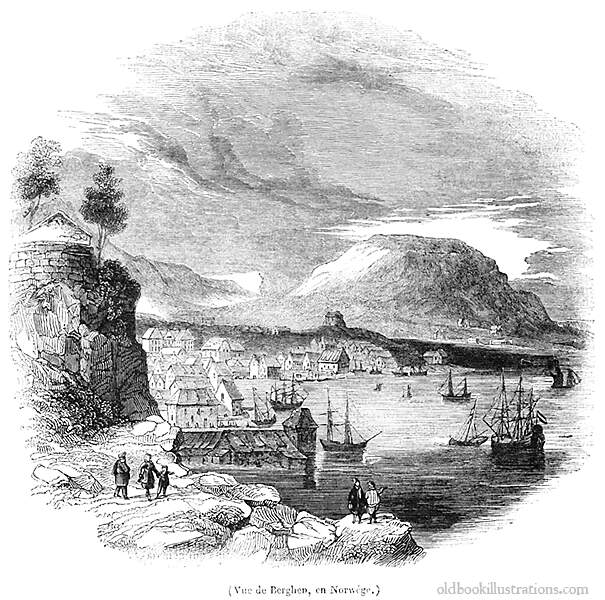
Bergen, Norway. This picture was taken from the periodical Le Magasin Pittoresque, Paris, 1840. Oldbookillustrations.com/Creative Commons.

Bergen, Norway. This picture was taken from the periodical Le Magasin Pittoresque, Paris, 1840. Oldbookillustrations.com/Creative Commons.

Nørwegian Style has tons of short-games, RPG poems, playsets, and «meditations over role-playing games», all in English.

Unfortunately, it’s all chronological and has little in the way of an index, so you either have to scroll through or know what you’re looking for. Some recommendations: Archipelago III (GM-less storytelling game with some innovative mechanics), Fiction – A flexible freeform framework (what it says on the tin), Until We Sink (a collaborative GM-less storytelling game aided by cards, fairly innovative in its day), A Trip to the Moon (a very nice game that’s a bit like a good-night fairytale. I remember it as a very pleasant experience, but haven’t played it in 12 years).

This blogpost by American author Lizzie Stark gives an introduction to the label «American Freeform», and a selection of games, all given a brief introduction. Ten of them are labeled as «free downloads».

There has recently been a 200 Word RPG challenge, the final results will not be announced until Thursday, as this is being written. But there are lots and lots of interesting games there, and this address, currently, lists the finalists: http://schirduans.com/david/2015/04/200-word-rpg-challenge.html

Howling Tower has a list of OSR games. I’m not familiar with these (I tend to just play D&D if I want to play D&D). The list is organized alphabetically, but there’s a short but fairly thorough review of each game. The aim seems more to have been to include the games that have some kind of merit, rather than every single OSR game ever put online for free. Which I think is a good choice, when making such compilations.

There are about 50 (?)downloadable freeforms on the Golden Cobra contest page, but it requires some patience to navigate. Besides the «honorable mentions» page, there doesn’t seem to be much of an overview/presentation on the page proper: http://www.goldencobra.org/

Our Many Games is an interesting, ongoing initiative to showcase games from game designers of a great variety of backgrounds. There’s already quite an impressive collection of links, in separate categories (table top, “freeform larp” and family friendly). Some games are free downloads, others you have to pay for.
Game Chef is an annual competition where you try to make a complete, short role-playing game in about a week. It’s been running for several years. There’s a history section over on the site. There’s probably a lot of interesting stuff to learn about the trends and developments of games and individual designers in the indie community. However, it looks to me as it will require some patience to navigate. Some links are dead, some will lead you to a forum, sometimes you’ll find the finalists entry but not the runners-up, etc.

I have no idea what this fish is doing here. Oldbookillustrations.com/Creative Commons.

I have no idea what this fish is doing here. Oldbookillustrations.com/Creative Commons.

Onesevendesign seems to have about seven free, short RPGs for download. I’ve heard a lot of good things about “Lady Blackbird”, but haven’t played it myself.

Shifting Forest has about ten games, short larps and story-games, available for download. None of the scripts are familiar to me, but it looks interesting.

Jason Pitre has put together a nice, at the time of writing fairly short, list where  he’s hand-picked six games he recommends (a good variation of genres and formats).

The FOSsil Bank has a long, long, list of free RPGs and larps (and other games). It’s sort of exactly what I wasn’t looking for: organized alphabetically, probably quite comprehensive, but no recommendation lists, real reviews or anything telling me what is good and what is just… old.

Similarly, DriveThru has a whole section with Pay-What-You want RPG products, but I have absolutely no clue where to begin, what is good and what is… less so.

… aaand 700 more games to choose from over here: http://www.1km1kt.net/cat/rpg (seem to be organized chronologically).

If you want to jump in the time machine, John H. Kim’s list of free RPGs was valiantly updated for years. This page hasn’t been since 2003, though, mercifully for him (organized by category/subject, and with a helpful intro page highlighting some favorites).

When Alexandria.dk update their English-section, I’ll give that a much more prominent spot. I’m amazed by what the Danes have accomplished with their scenario database over the past several years. The presentation “leaves something to be desired” (I think it’s fair to say that goes for many of the entries. And this list, too, probably).

I considered including the sites of individual creators/companies like Bully Pulpit, Lumpley, Jackson Tegu, Buried Without Ceremony (seems to be down at the time of writing) and others, but then I would probably be sitting here well past my bedtime, so I’ll leave the rest of the hunt to you. Best of luck!

;)

(Feel free to add your own favorites in the comments. I might edit in some stuff later if I feel I’ve missed something important).

World Building for RPGs


Many of us are fond of creating new settings and worlds, both for use in role-playing campaigns, but also as a hobby unto itself. 

In 2012 I wrote a short chapter about this in “The Little Book on Role-Playing” (in Norwegian). This is an expanded follow-up, that can be read independently of the first article. 

At the end of the article, you will find a list of exercises to get you started. Thanks to Ara Kooser for valuable input.

Some of my main points from the first article:

Procedurally bound meticulous,  «top-down» methods are difficult for me when I reach some element that doesn’t turn me on. Say «wind patterns», «laws» or something. It gets hard to push through, and I’ve often laid my worlds aside.

Figure out what the world is for. Role-playing games? A novel? Various uses could demand different approaches to world building.

Leave aside apocryphal, obscure details that will never see play (or the reader will never meet). Stick to the juicy stuff, at least for now.

Illustration: Karenswhimsy.com

Illustration: Karenswhimsy.com

For an RPG, focus on setting elements the characters will actually interact with and, preferably, are able to affect/change.

Collaboration is good. Listen to your players, they’ll give you cool, free ideas and pointers to what they’re interested in. Maybe even involve them directly in the world building process, if they’re so inclined.

This article presumes you’re building a role-playing setting, and most of the examples are from fantasy worlds. But I believe many of the ideas could work for other types of settings as well.

VISION

I think it can be smart to start with some kind of common vision or mood you wish to convey. It can be from a genre, like “action archeologists explore jungle-ruins in South America with lots of wild monsters and Nazis”, some scene types you wish to make room for: “a lot of climbing over roofs and burglary in tall towers”. “Meeting demonic, tentacled creatures from the other side of the stars”. “Corrupt court intrigues”.

The vision can also tell us something about what kinds of characters we’ll see: «nobles with a focus on feudal loyalty and ancestral bonds» or «rough barbarians trying to survive in the wilderness, as civilization draws near». With the vision at the back of your mind I think you can get a lot of free ideas when you’re establishing other parts of the setting.

The other elements aren’t organized in a prioritized order. Start with what seems most inspiring right now, leave the rest for later.

COLLABORATING

Maybe you’d like to meet up, and spend an afternoon/evening developing the basic concepts. Maybe you’d like to write a few e-mails to and from. Some like using a Wiki, others find it to be a bit of a hassle.

Who’s in, who has the final word?
It could be a good idea to choose a «main editor» who has the last say on what goes in the final setting manuscript (or wiki, scroll or whatever format you choose). Maybe it’s sufficient if a couple of you work out the main concepts of the world, and then others can add later on (through character backgrounds, by being given special responsibilities for certain areas, or by taking turns being the game master).

When we recently established a fantasy setting on Mars for a D&D5 campaign, we mainly used e-mail correspondence. The players wrote down their thoughts and ideas for characters and concepts surrounding these: the people they belonged to, and the areas they were from. We met two “problems” which both found a solution. One thing is that I wrote far more than the others. But my character was the only one from Earth, so that whole domain was sort of left to me. A more tricky problem was when two of the other players created character concepts that were “mutually exclusive”; one player thought their people’s biology and gender worked in a different way than the other player envisioned. I think it was solved simply because one of these players couldn’t join the campaign after all. But those are the kinds of challenges you can face when attempting collaborative fiction.

For some ideas to how you can structure a collaborative process/conversation, I suggest you have a look at the «phrases» in the game Archipelago III for inspiration on how this can be handled.

GUIDELINES

My friend Magnus and I sit down and create a campaign concept together , I don’t think we’d really need many «formal rules». We could base ourselves on normal, everyday conversation. We’ve known each other, played role-playing games and designed things together for 16 years. We have similar tastes in fiction. It would probably have worked just fine.

The more voices who are to be heard in a collaborative process, and the more people who don’t know each other in advance, the more need there can be for some “social contracts”. 

When my friend Maja held her «World Building Workshop» at HolmCon one year, she started by having us make a list over concepts we didn’t want to have in the setting. I think we took turns around the table, where everyone could veto one concept. E.g.: no zombies, no steampunk, no dick jokes, etc. At first I was a bit skeptical; this was almost the opposite of a brainstorm, I thought. But I also saw how it contributed to us finding out where we wanted to go by clearly defining where we didn’t want to go. 

Taking turns around the table is also a good way of making sure everybody gets to contribute, or you could limit how many e-mails with new setting information Ole Peder gets to write every day, etc. 

Brainstorm is defined by a “say yes”-attitude. No ideas are too stupid. We throw out everything we can think of, build on other’s ideas and then later on have a process of trimming away what doesn’t fit in, or concepts we don’t believe in. In this trimming-down process, it’s important not to be “married” to your ideas.

Could this work as a map? Illustration: Catherine Mommsen Scott/Flickr.com/Creative Commons

Could this work as a map? Illustration: Catherine Mommsen Scott/Flickr.com/Creative Commons

MAPS AND GEOGRAPHY

Maps can be a nice visual focus. It’s sufficient with a rough sketch at first. If one of you enjoys drawing, she can make a more refined version later. Use simple symbols, so that everyone can help draw. Leave some white spaces on the map, to be filled out when the need arises later.

If it’s a fantasy setting: some mountains here, a coast line there, some islands, woods… If the setting is a starship travelling between galaxies: some kind of simplified plan of the ship. City environment: main streets, harbor area, important nodal points, define the largest boroughs, etc. 

As you draw the various symbols and topographical elements on the map, tell the others a bit about your suggestions. They can then follow up with their own input.

Rolemaster had something called «Campaign Law» which actually has a quite inspiring «quasi scientific» guide to building cosmology, geography (and societies, later on). It can be found over here.

CHARACTERS

Some of the character concepts can be established while building the setting. What kind of stories are you making? How do the characters belong in these? Are they nobles or wandering adventurers? Where are they from originally? What’s that place like? How has it influenced them?

In addition to characters, it can be nice to imagine some secondary characters (NPCs), both well off, powerful and good/bad/ugly: the king of the River City, the import baroness of the Hill Country, the wizard in his tower. But also consider those one rarely thinks about, but who might have an exciting destiny: the inn keeper who runs the northernmost tavern in the world, and gives the characters a hideout from ghosts, the mother of one of the characters who has been driven away from her village, the street urchin who can control fire.
Characters and NPCs can be tied to each other in relationship maps, where you draw some arrows connecting them with words like “rivals”, “lovers”, “best friends”, etc.

WHY ARE YOU MAKING THIS?

As I wrote initially: What’s the purpose of the setting? Is it for a role-playing campaign? How long will it be? Can the world grow as you explore it, or do you want lots of details before you begin play? Is it sufficient if the main concepts are firmly established, or do you want to know every detail about major cities, important leaders, culture, history and religion? It’s a different job to create a world for a series of novels than for a role-playing campaign (at least I tend to think so). In the campaign it can actually be a bonus with “blank areas on the map”, even for the game master. It gives you more freedom to improvise, the engine of role-playing.

It might be a different job to type up a short, focused campaign than one that will support scores of sessions. Make sure you save some of the enthusiasm for play proper! You’ll learn a lot about the setting by playing in it. Make things short and focused. Write it down, but keep descriptions brief. Keywords or a few sentences may be enough. It can be hard to get everyone involved in updating a Wiki or writing recaps after game nights. Not to mention the fact that not everyone bothers to read all that material. But it’s an important task, to let (especially the game master) keep track of the world as it grows and branches in your collective imagination.

SOME TYPICAL ELEMENTS

Some starting points when discussing the setting. Establish some of these, but you’re welcome to keep it brief and sketchy. Skip to the next topic when you feel you have some fun ideas established. It’s enough to say “monotheistic religion dominates society”. The details about the church, its rituals and hierarchy can come in play later on or next time you meet. Establish a few main points of interest first, the large, heavy elements that butt against each other and create interesting tension.

Maybe you're build a retrofuturistic setting?  Illustration: Louis Glanzman. Creative Commons.

Maybe you’re build a retrofuturistic setting? Illustration: Louis Glanzman. Creative Commons.

Establishing these elements can also be made into a game within the game, if you’re so inclined. See, for instance, how it’s done in “Microscope”, where you explore and build a setting through playing out short scenes from its history. Or “Shock”, where you define social issues the science-fiction world is about before you engage it through play.

CONFLICTS

It can be good to establish some large, overarching conflicts in the setting. Which groups are pitted against each other? Is there a battle over certain resources? Do you have some kind of «Evil Overlord»? Or several? Here you can both consider real history, social anthropology etc, or think in «purely dramatic terms». Maybe there’s a particular kind of social rules that are the source of eternal tension in society? The elves have to sacrifice a hundred human souls every year to appease their gods = conflict between the elves and humankind. Those who are not baptized become evil undead upon death = great pressure to be baptized. The church may have huge territories, but few weapons. The nobles may have weapons, but their lands are of less value because of war, drought, heritage systems splitting them up = conflict. Conflict is usually considered the classic recipe for drama. Not necessarily the only one or the most interesting, but at least one it’s good to be aware of. One group wants one thing, one or more others want something else, and there’s conflict.

«Shepherd Boy». Kilde: Watts, Arthur: “A Painter’s Anthology” (1924). Public domain.

«Shepherd Boy». Kilde: Watts, Arthur: “A Painter’s Anthology” (1924). Public domain.

HISTORY

I’m not a great believer in tens of pages with timelines, but it can be good to sketch out some important events in the world’s history. Large wars, plagues, discoveries, technological advances, migration, etc. I’d suggest you make a sketch of the earliest history, going into more detail as you approach the date when the game will begin.

MAGIC AND RELGION

It can be good to picture which gods and supernatural forces people believe in, and what kind of magic exists (if you want to have magic in the setting). There are many rich traditions in our own world you can be inspired by. Maybe you’d like something reminiscent of a Greek (or Norse) pantheon where the gods are archetypes reflecting aspects of the human mind or nature itself. Maybe you want a monotheistic religion, or maybe there’s some kind of mystic order dominating society, with a clergy who want to achieve illumination, unity with the Godhead or something similar. Maybe magicians are shamans, going on “spirit travels”, eating “magic mushrooms” and contacting the elemental forces of nature. Maybe you have traditional fantasy wizards reading up on the dark arts in tall towers (I’m sure you and your creative players will be able to do something interesting even with that old trope). Are there monks, nuns and monasteries? What kind of rules apply there? What is the religious tolerance in society like? Are heretics burnt on the fires of the Inquisition, or are you free to believe whatever you want?

POLITICS

It can be good to define the most important geographical areas and write a bit about how society works there. Are they large empires, tiny city states or a mix? Are they feudal societies, oligarchies, or organized in other ways? Do you have contested border areas where war still reigns? What is life like for the peasants and commoners of those areas? Fantasy societies often feel a bit like the Medieval Ages in Europe, with farmers, nobles and clergy, and feudal structures where the nobles swear loyalty upwards in a «power pyramid”, with the King/Queen/Empress on top. Some of the tension in these societies is based on the power struggles between the various orders, but also internally in the nobility, and between the nobility and the king. Maybe you’d like to be inspired by other historical societies, or try to construct something of your own.

GROUPS

We’ve already touched on nations, religious organizations, social orders and others. There are probably other important groups in the societies you create. Maybe guilds are important, a kind of proto unions for various kinds of workers and craftsmen. Maybe there are criminal organizations. Are «adventurers» organized in any way? Rebel groups, heretic sects, non-human intelligent creatures.

THE SUPERNATURAL

Building on what you’ve established about magic and religion, you can consider if there are any fairy tale creatures, demons and other supernatural beings in the world. Maybe you’d like to use elements from games already published (the D&D Monstrous Manual comes to mind). Maybe you’ll base yourself in the folkloric traditions of a specific country in our own world, mythology or other historical sources. Or try to create monsters from the ground up. If any of these creatures are intelligent; how are they organized? Do they live in societies? Are they part of human society, living in cities, or are they living in deep forests and dark valleys, hidden to the eyes of man?

WORLD BUILDER EXERCISES

Some creative tasks to jog your group’s imagination. Can be solved individually or as a team effort. I’d advise against trying to solve all the tasks. Pick 1-3 you like. 

You can also make up more exercises yourselves.

* Draw a creature or person from your world.

* Who is an outsider in your setting? Why? What does it mean to be an outsider? 300 word limit. 
* Describe a sacred site or object. Use as many characters as you want, but do not explain anything about the setting cosmology in your description.

* Write down three words in one of the languages of your setting.

* Write down five keywords about the mood you wish to convey.

* Use at most 1000 characters on a mood text about the setting.

* In five sentences, describe how religion works in people’s daily life.

* Write down a brief timeline.

* Decide which element in the setting you are least happy with. Delete it from your script.

* Think of three movies/books/comics that would work as inspiration for your setting.

* Find a photo or illustration with Google Image Search/Flickr/Wikimedia Commons that matches your setting.

*Invite some friends. Tell them about your setting. Take their tips, write them down.

* What is the worst profanity uttered in your setting? Why is this so bad to say?

* Do the gods exist?

* Which event on your timeline would you most have wanted to witness?

* Which event on your timeline would you avoid being present for at all cost?

* Create a character for any role-playing game that would fit with your setting.

* Which person would you most like to be in your setting?

* Choose an area on your map. Write five sentences about this area.

* Describe the three most powerful people in your world.

* Describe three of the least powerful people in your world.

* Describe a war in no more than 1000 characters. Who fought whom? Where did the major battles take place? Who won and why? What consequences has the war had? What was the war fought over?

* What is the oldest civilization in your setting? Does it still exist?

* What remains are there after this civilization? If it’s still alive, how has it changed over the centuries?

* Create a Spotify playlist for your setting.

* Describe the three largest groups of people, briefly.

* Pick one of the three. Describe their culture, briefly.

* Write down as many keywords (not complete sentences) about the setting as you can.

* Choose an area/people/city in your world. Write down a list of keywords and loose associations about it.

* Write down three sketches for cool/interesting scenes that could happen in your setting.

Earrings found in 1915 by Gyeongju. The diametre of the circle in the middle is 3,5 cm. Photo: National Museum of Korea/Wikimedia Commons/Creative Commons.

Earrings found in 1915 by Gyeongju. The diametre of the circle in the middle is 3,5 cm. Photo: National Museum of Korea/Wikimedia Commons/Creative Commons.

* Write down three sketches for supporting characters.

* Write down three sketches for campaign concepts.

A Letter from Fastaval

fastatoThe Danish role-playing/freeform/semilarp convention Fastaval is held in Easter every year. It draws several international participants. I came here for the first time last year, and was instantly hooked. So many slightly pretentious storygame nerds like myself in one single spot. Hurrah! The main attraction for me is the scenario tradition they have here.

Every year, around 30 scenarios are written especially for the festival. On Sunday, there will be a galla evening in mock Oscar style, where the prestigious (and slightly silly) golden ”Otto” penguin statue is handed out in various categories; best script, best story, best methods, best characters, etc.

I’ve gotten to play five games this year. I’ll write a little about each experience:

This Miracle
A game simulating religions. I only played parts of this. The warm-up/set-up was perfect. Probably the best warm-up I’ve seen in this kind of game. There was chanting, we told a collective story (that worked amazingly well considering how many players we were), and we told each other about our favorite mythological characters. Loki, Baron Samedi, The First of The Fallen, etc. I felt very smart telling the group about my relationship with Peter Parker. Then we picked Jungian archetypes to play in the game proper. Only trouble is, I felt I was being prepared for something very different from what I later got to play.

The game has an ambitious structure. We started with a large group of maybe twenty people, who were later divided into smaller groups who were to establish various myths from a fictitious religion, craft physical artifacts representing the myth, that were later handed over to other groups as the myth was passed on. So the various groups interacted, and obviously had to be timed and coordinated. There were some later stages to play, but in the end I opted out of the game. The group I was in was a little dysfunctional, the GM seemed slightly stressed and curt, and I was tired from lack of sleep (I’d spent too much time the night before fiddling with me and Magnar’s Nordic Larp Generator).

I was initially psyched to play the Jungian archetype I was given during warm-up. I picked ”The Ruler”, since I’m not very much of a Ruler in RL. I had started looking forward to playing some kind of mix between the elder Lannister in Game of Thrones and Obama. But when we were split up in smaller groups, we went straight into collaborative storytelling. I think we were supposed to play our archetypes narrating the myth, but I quickly realized me being a stern, pompous Ruler in that circumstance would be of no use to anyone.

So anyway, I left the game, as it seemed it wouldn’t break the game for the remaining players (there wasn’t any pre-established plot depending on my character’s presence).

Room
A surreal ”semi-larp” about a boy and a mother who were held captive in a shed by a man (who was secretly the boy’s father). All told from the child’s perspective, with the room itself as a ”meta-character”. Semi-larp means you push tables and chairs aside and act out the characters like in improvised theatre or larp (obviously). But unlike larp there are no costumes, and you don’t change locations much. Fastaval games are mostly played in the classrooms of the school where the convention happens. So that’s the physical setting we have to work with (no castle).

fastavalI was the game master for this, and it was my first time running a game at Fastaval. I don’t have that much experience facilitating this kind of out-on-the-floor freeform. So that was an interesting experience. When actual play started, after the set-up and warm-up, my job was mostly to establish and end scenes.

The backstory of the scenario reminded me of those weird and terrible stories of women held captive for several years in Austrian basements, but the pure horror of the boy and mother’s situation was consciously subdued by the author of the scenario. Placed in the background, as the child’s fantasy world, interacting with his imaginary friends in the room, was at the forefront.

Our run wasn’t perfect, mostly because of my inexperience with the format, but I found it to be an interesting and at times moving/intense experience.

Grotesque
My favorite this festival was a comedy about an art scene (not at all similar to the Nordic Larp/Nordic freeform scenes). The characters were a group of men who were in an art group doing some kind of improv/performance stuff for large audiences. Play switched between present and past, doing flashbacks to their time of notoriety and big shows, contrasted with the slightly more has-been vibe of present day, with some comeback aspirations mixed in.

The author, a Danish stand-up comedian and Fastaval veteran, ran the game for us. This was a sit-down game, play happening purely in our conversation and whatever body-language and facial expressions you can do sitting down (all the remaining games were, so I won’t repeat this).

Tales from Five Fallen Realms
Nano-games! The concept is as follows: you’re divided into groups, but there’s no game master. You’re simply given five different games, each written on a postcard. Then the groups select however many games they want to try out during the two hour period they have availbale (the other games I played were in 5 hour slots, but didn’t always last that long). Our group selected The Bunker and Split Utopia.

miracle

Artifacts crafted during our run of «This Miracle».

– Split Utopia was a world-building sci-fi game. I thought the rules sounded a bit boring at first, but it worked really well. We established various aspects of a sci-fi setting, and then narrated how it gradually crumbled. All of this was GM-less, so we had to depend on whatever experience the players had with improv and collective storytelling. There are limits to how many instructions fit on a postcard, but fortunately the group seemed very experienced.

– The Bunker was a post-apocalyptic sci-fi (crumbled societies being the theme of this year’s Nanogames). We played a group of astronauts who had returned to the remnants of Earth, exploring a bunker which was (in our game at least), ”Humanity’s last stand”. Then there were flashback scenes were we got glimpse of what society was like before the fall. It worked quite well, and we told a fairly coherent story, but it suffered from some of the faults I often see in GM-less games, where you have small tug-of-wars between the players. Saying ”say yes” is fairly easy, actually playing that way requires both the will to let go and maybe some experience doing just that.

Demons
In signing up for games at this year’s Fastaval, I consciously tried to avoid the ”heaviest” topics. There were mental institutions, abusive fathers and war widows to be had, but I largely stayed away. However, the two designers of Demons had given me very strong experiences with previous games, so I gave ”Demons” a go.

The characters were Korean ”comfort women” during the second world war. Sex-slaves in a Japanese concentration camp. I had some superficial knowledge of the topic before I went to the game, but no more than that.

I won’t do the scenario justice here, but I’ll jot down some brief thoughts:

– The designers had chosen a kind of ”magical realism”, where the world of the women gradually became more dreamlike, and their captors turned into actual demons (animal-like caricatures).
– Was it torture porn? No. We were instructed to tone down that kind of play, so the worst things were rarely made explicit. Scenes were cut, there were muted sounds instead of direct narration of certain scenes etc. It worked fairly well.
– Do you gain direct experience of a historical period through RPGs or larp? No. But you may learn stuff, gain an interest to explore further, and so on. I’ve never really given the topic ”what would it be like to be an 80 year old Korean woman who survived a Japanese concentration camp” much thought. Maybe I will now. My grandmother, who is still alive, has sometimes told us how angry she was when she witnessed German soldiers parading Russian (?) prisoners in Norway during WWII. We could have been other people. I think role playing can help us empathize.
– I don’t understand, but I can try to.

Yeah. I won’t go further into it right now. Maybe later, when it has had time to sink in a bit. The game was only five hours ago.

Those were the games I played. Other than that, I’ve enjoyed being able to hang out with people I usually just interact with on social media the rest of the year.

I also got to do a Nordic Larp battle-rap with Evan Torner. That’s probably the nerdiest thing I’ve done so far this year, and I do fairly nerdy shit all the time.

Love from Denmark.

(Most of these games will be made available on http://alexandria.dk, primarily in Danish, but sometimes they’re translated to English, too at some point.)

This thing of ours

foundationstoneREVIEW:

The Foundation Stone of Nordic Larp
Knutpunkt 2014

Edited by Eleanor Saitta, Marie Holm-Andersen & Jon Back

(318 pages)

The annual larp conference Knutepunkt (alternating between four of the Nordic countries) has a tradition of putting out one to several anthologies with larp-related essays. This year, there are two books. Both are available for free download here.

Imagonem has previously reviewed The Cutting Edge of Nordic Larp: Chewing on the Cutting Edge.

The Foundation Stone is meant to serve as a primer to the “Nordic Larp discourse”. It has some new essays commissioned especially for the book, but mostly consists of papers, articles and essays from previous Knutepunkt anthologies.

The papers selected from previous Knutebooks represent “games from the perspective of the player and theorist”. That means papers written especially with the larp designer in mind have been consciously left out. Larps used for educational purposes are also not covered. That probably makes the book less practical and hands-on than some might have hoped for (I’ll let you know that a certain well-known Nordic larp theorist and designer is currently working on a book specifically on larp design, though).

HAMLET (2002). (Photo: Bengt Liljeros)

HAMLET (2002). (Photo: Bengt Liljeros)

The Foundation is a good primer if you’re interested in larp (or even roleplaying in general) considered as a form of expression with artistic potential. It’s probably also of value if you’re into role playing theory or game research. It gives you an overview of discussions that have taken place, terminology in current use, and presents a smattering of interesting, often avant-garde, projects.

Some of the texts are quite high-flying and abstract, and don’t shy away from using complicated terminology and namedropping more-and-less obscure philosophers and academics. Some are more straightforward reads.

The copy-editing seems much better than in the “Cutting Edge” anthology, at least to my untrained eyes. Some essays have photos, most don’t (I think this is a consequence of what they looked like in the original anthologies). The layout is clean and functional.

If you want to approach these texts, I suggest doing so at your own leisurely pace, rather than reading as fast as you can in order to write a review no one really asked you for (well, except Anders, bless his heart) just in time for Knutpunkt.

Disclaimer: I’m acquainted with many of the authors, and consider quite a few of them friends. I’ve played some of the games mentioned in the book, and have dipped my toe and various other appendages in this scene for years. So I’m not really much in the way of an objective, neutral source.

TOTEM (2007). (Photo: Rasmus Høgdall)

TOTEM (2007). (Photo: Rasmus Høgdall)

Here’s a walkthrough guide to the book, where I go through the essays one by one. I hope this will prove useful in finding your way to the essays that’ll interest you the most:

The first part of the book is a presentation of some selected “Nordic Larp Talks”. These are short (between 10 minutes and half an hour), TED-talk-style video presentations on various larp-related topics. The PDF has both QR codes you can scan with your cellphone and links to the videos on YouTube. I haven’t seen all of these, but the Nordic Larp talks I’ve attended have been both good and entertaining. I suggest you see if you find a topic that interests you and go have a look. All of the videos are presented at nordiclarptalks.org.

Then there are three essays on “The Nordic Larp Community”.

Andie Nordgren has an essay titled “A Community Shaped by Participation”, where she talks about how the Nordic social and political context has shaped the community, and argues that you have to take part in order to actually understand how larp (and this particular larp tradition) works. She concludes that the tools, skills and perspectives you gain by larping and organizing larps are also applicable beyond larp itself. “I personally hope this book can be a way for larp to meet practitioners from other fields with a wish to shape reality – to trade tools, methods and visions for possible futures – real and fictional.” This sentiment is quite typical of the Nordic Larp mentality/discourse, and may be seen as a somewhat radical notion. Especially if you’re in the “roleplaying games are only a form of entertainment/hobby” camp. And it goes beyond mere talk and theorizing: quite a few participants in the Nordic scene make a living doing educational larps for schools and organizations, several larps with a political message/intent (usually of the left-wing variety) have been run, some have experimented, or continue to live in, relationships on the side of “heteronormative” practices, and (in the same vein) some use the tools/mindset of larp (and various political theories) to challenge base assumptions of identity, gender and so on.

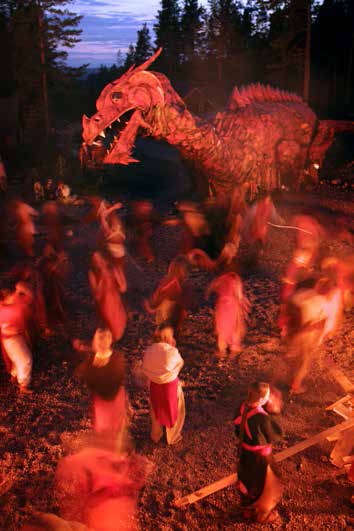
DRAGONBANE (2006). There was a dragon. It didn't breathe fire. (Photo: Janne Björklund / Kuvateko.com)

DRAGONBANE (2006). There was a dragon. It didn’t breathe fire. (Photo: Janne Björklund / Kuvateko.com)

An Introduction to the Nordic Player Culture (Helene Willer Piironen & Kristoffer Thurøe)
Tries to explain some core concepts typical of many larps in the “Nordic tradition”, like immersion (to a certain extent “forgetting yourself” during play), “bleed” (when your thoughts and feelings are influenced by those of your character, or vice versa), “playing to loose” (setting your character up for failure), transparency of design, co-creation of setting and character, and so-called “meta-techniques”. The essay admits that not all of this is readily accessible to a newcomer in the form of essays or guides on what constitutes “good play” in this particular tradition. It also suggests that the best way of learning to play Nordic larps is to, well, play them, and invites the reader to come do so. The authors don’t necessarily mean that you can’t have use of the Nordic canon of theory, practice and methods outside of the Nordic countries, although they give an example of how it can be hard to transfer the player culture to an environment where the players have trained themselves to think of gaming in a different way. “We still believe that the best way to get the full picture is to come and play our games with us. We would love that.” That might be beyond the time and means of many readers, though (and Nordica is kind of expensive). Personally, I believe that there’s plenty you can learn, adapt and take home to spice up your local tradition in both this book and other parts of the voluminous output of Nordic Larp over the years.

Knutepunkt — A Love Story (Margrete Raaum)
Since 1997, Knutepunkt has been the social and theoretical hub of the Nordic larp community. This essay shares some of the convention’s history and peculiarities. “Even if we come from an expressive cultural tradition by Nordic standards, the weirdness of the Knutepunkt crowd is ridiculous — at least during the Knutepunkt weekend. There are no mundane people. It’s like an energetic porcupine.” The essay is short and enthusiastic, and probably a good primer if this is your first year at Knutepunkt or if you’re considering going sometime.

The next part of the book is titled “Essays from the Nordic Larp Discourse”, and consists of a choice collection of essays from 13 years of Knutepunkt anthologies. All the essays have short, new introductions written especially for this book.

(Photo: Dragonbane project)

(Photo: Dragonbane project)

Play to Love – Reading Victor Turner’s “Liminal to Liminoid, in Play, Flow, and Ritual; An Essay in Comparative Symbology” (Martin Ericsson)
Ok. Well. We’re off to a start with a real easy and accessible text. Real tabloid stuff (I’m being sarcastic). Ericsson has a look at larp through the lens of something called “performance theory” with which I’m personally not familiar (it seems to spill over into something akin to anthropology?) and the ritual drama of ancient societies: “(…) it seems clear that current larp-practices share more traits with dramatic ritual than with any other form of human behaviour.” This seems to be meant used not only as a tool for (pseudo?)academic analysis of a fun pastime, but rather a radical mission statement of using larp to change yourself and the world. “The ideal player must become a Liminaut – a free explorer of the threshold realm – and abandon all illusions of being an individual defined by the fetters of her mundane prison of self. The equation is as simple as it is potent: to truly play one must be truly free.” For someone who has a cursory interest in Chaos Magic, social rituals considered as games for both subjugation and liberation, identity and stuff like that (me, for instance) it’s kind of inspirational and feels like a throwback to my early twenties. Maybe I was onto something then I may have forgotten. You also get to read fun words like “ethologically” and “quadrilogical”, which I personally didn’t bother to look up.

Temporary Utopias – The Political Reality of Fiction (Tova Gerge)
The essay looks at the Swedish larp Mellan himmel och hav (Between Heaven and Sea) from 2004, a sci-fi story about an alternate society inspired by the works of Ursula K. Leguin and feminist identity theory. It initially claims to use “the larp (…) to look at how themes and dramatic structures correspond with political focus.” I’m not really sure what that means, or whether the text accomplishes it. It does however give a sketch, an impression, of what sounds like a very interesting game by describing some of its structure, scenography and methods. The larp played around with social structures and the concept of gender. Gerge states that many players were deeply affected, both during and after the game. She touches upon a similar theme as Ericsson in the previous text: “Role-players are slowly deconstructing the wall between reality and game”. To me, it would have been interesting to hear more about this aspect of the game, not only what happened during actual play, but also what kind of social and emotional impact it had in the time after. Maybe those stories would be too personal to tell, maybe it was beyond the scope of the essay, or maybe the time wasn’t right only a year after the game.

AmerikA (2000).

AmerikA (2000). (Photo: Britta Bergersen)

Lessons from Hamlet (Johanna Koljonen)
“The last three acts of William Shakespeare’s Hamlet were reproduced as a three-day larp in Stockholm in 2002.” Kind of a meandering essay reflecting on a larp experience in hindsight, a larp considered “important” in the “Nordic Larp discourse” (like most of the larps mentioned in this book, probably). It gives you a certain impression of what it was like as an experience and how it was organized, both logistically and with regards to rules and written material. The essay also says something about what Koljonen has later called the ideal of the “360° illusion” in many Nordic larps. It’s a personal, subjective essay, and (to me) also a testimony to the difficulty of communicating why and how a larp experience felt/was important.

High Resolution Larping (Andie Nordgren)
Introduces the term «high resolution gaming», using the game Totem (2007) as an example. Totem had a tribal setting, where one of the main focuses of play seems to have been the character’s positioning in the tribal status hierarchy. Nordgren gives an introduction to both the game and some of the methods used; workshops and various symbolic ways of representing aggression and conflict, sex and relationships. She emphasizes the interaction of the characters, and the preparatory work for enabling the interaction, as a key to creating the detailed, subtle play experience she characterizes as “high resolution”.

KAPO (2011): It's all fun and games in Denmark.

KAPO (2011): It’s all fun and games in Denmark. (Photo: Peter Munthe-Kaas)

Without using the word, Nordgren also touches upon the concept of “bleed”: “It could be argued that when we have access to increasingly subtle diegetic communication, the things communicated in a game could spill over into our lives outside of the game, making it harder to uphold a sharp boundary between ourselves and the characters we play.”

Eye-Witness to the Illusion – An Essay on the Impossibility of 360° Role-Playing (Johanna Koljonen)
Presenting the concept and ideal of the “360° illusion” in larping. Basically I take it to mean something like “what-you-see-is-what-you-get” 1:1 environments, where the player’s surroundings; houses, furniture, decorations and so on all exist in the game setting. The title implies that such games are “impossible”, as there will always be some non-diegetic elements present. The essay itself is more forgiving, however, and open to this approach as one possible way to go when designing games – with both benefits and drawbacks. The essay also touches on various other topics, like visualization, the symbolic and physical borders delineating the gaming space, different approaches to role-playing and immersion, and more.

Social Reality in Roleplaying Games (Markus Montola)
This is a new essay, commissioned especially for the book. It gives a brief introduction to a framework for discussing and analyzing pervasive games and roleplaying the author presents in more detail in his doctoral dissertation.

Montola bases his framework on something called “social constructionism”, developed by the philosopher John R. Searle. Basically, reality is viewed as consisting of two layers, the social reality (immaterial things) and the brute reality (material things). The rest of the framework follows from this model.

MAD ABOUT THE BOY (2010). (Photo: Li Xin)

MAD ABOUT THE BOY (2010).

I found it a highly interesting and worthwhile read. It deals with fairly abstract topics, but does so in a clearly written and accessible way.

I also find the text to have some deeper philosophical implications about the social world(s) we live in and, check it out, help create. These implications are both fun, empowering and somewhat scary to think about.

Consider this:

“The Monitor Celestra is a good larp to use to illustrate this framework, as it was set in the somewhat well known universe of Battlestar Galactica. In that game I had the status of being Major Darlington of the Colonial Fleet. That status was based on the same kind of social mechanics that assign the status of legal tender to a piece of paper and make Barack Obama the President of the United States.”

Ok. So the position of being the most powerful man on the planet is a social construct? Something possible only by way of consensus, because it’s agreed upon as fact? (obviously supported by quite a lot of very “brute facts” indeed, heavy weaponry for instance). What does this tell us about smaller social games we play in “real life”? About roles we assign to ourselves and others? If this is true, what can it be used for?

I’ll leave it at that. This book, and article, is “only” about role playing games. Which is just a fun and innocent pastime. Right?

THE WHITE ROAD (2006)

THE WHITE ROAD (2006)

Autonomous Identities – Immersion as a Tool for Exploring, Empowering and Emancipating Identities (Mike Pohjola)
Immersion, again. I found the introductory paragraphs to be somewhat tedious, referring to a bunch of models and manifestos I’m only superficially acquainted with (e.g. The “Turku Manifesto”, presented later in the book). The first part of the essay I found a little boring. It shows some ways of describing roleplaying games, even giving a definition. In this day and age, I’m happy to just nod and wink: yes, that’s a possible way of looking at it. The good stuff is hidden towards the end, where the author gets into stuff like the anarchist concept of “Temporary Autonomous Zones”, and suggests that the tools of larp can be used to create “Temporate Autonomous Identities”, always available to the player, which can help you both “game” and “mold” reality. This echoes suggestions and sentiments we’ve seen in earlier essays (both Nordgren’s and Ericsson’s, at the very least), and the stuff I mentioned in the previous paragraph about the philosophical implications of certain ways of looking at role playing games. It also makes me wish I was around in the scene when these discussions where hip, to find some like-minded peeps, instead of sitting around in my basement doing Phil Hine-inspired wank magic and dreaming of “Ego destruction” and similar concepts. I feel old and static. Yeah, well. Some dream the revolution, some go do it. Others just go mad (for real).

SUBCOMMANDANTE MARCOS. Illustration: Gabriel Widing.

SUBCOMMANDANTE MARCOS. Illustration: Gabriel Widing.

My Name is Jimbo the Orc (Ulrik Lehrskov)
A blissfully simply worded essay at this point. Starts off by relating an anecdote of the “annoying-dude-telling-me-about-his-character”-variety, briefly skimming through the topic of “story attribution” and looks at how this can be used to analyze and re-tell larp experiences. Rounds off with describing a game of just such attribution, which actually sounds like a lot of fun. Not anything earth-shattering, but kind of a nice breather after all that has gone before.

Rules of Engagement (Emma Wieslander)
Considers the topic of simulating sensuous/sexual encounters, asks why there hasn’t been more focus on creating a framework for dealing with these topics in larp, and describes  one such method (the so-called Ars Amandi technique of hand-stroking). One of the more practically oriented essays in the collection.

The Nuts and Bolts of Jeepform (Tobias Wrigstad)
A nice introduction to the peculiar brand of Swedish-Danish (well, actually Nordic, at this point) freeform games known as Jeepform. It has informed some of the meta-techniques currently in vogue in Nordic Larp and “Blackbox style” larping (I think, at least, influences here seem a bit criss-cross and all over the place), and a lot of the key players are active in both scenes. So it seems a natural inclusion in the book. Jeepform is kind of like larp-influenced tabletop (no costumes, few props), using inspiration from improvisational theatre, psychodrama and whatever else they can get their hands on in order to tell high-impact stories (usually using some kind of director). The freeform tradition hasn’t been particularly strong in Norwegian tabletop roleplaying (I’m from Norway), and I sometimes feel we missed the boat in the mid-90’s (I’m an avid table top role-player in addition to doing the occasional larp). Fortunately a lot of these experiments, methods, games, and theories have been written down and shared online. Never too late, I guess.

The Positive Negative Experience in Extreme Role-Playing (Markus Montola)
Montola again. The PhD dude. I like Montola. Here he goes head-to-head with the “games are just for fun” camp, by exploring “gratifying but “negative” play experiences elicited by two freeform role-playing games.” The author looks at two games from the Jeepform collective (see previous paragraph), namely Gang Rape (which, as the name suggests, deals with rape) and The Journey. The author has interviewed designers and players, and participated in one of the games (The Journey, which is based on the post-apocalyptic novel “The Road”). It’s a serious study, by a serious author, on a serious subject. Highly recommended reading.

The Golden Rule of Larp (Simo Järvelä)
An essay about ethical considerations in larps, informed consent and player safety. Especially in light of the fashion (that may or may not be somewhat out of vogue currently?) for “hardcore games” and “extreme gaming experiences” like those mentioned in the previous paragraph, this is a highly interesting discussion. The article is well-written and clearly communicated. For the first time with one of these pieces, I actually feel it ends a bit abruptly (barely touching on the topics of safe-words and debriefs, for instance).

The Book of KAPO – (Claus Raasted (editor))
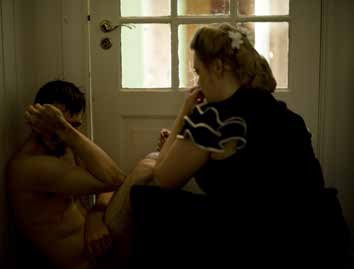
This is a curious addition to the book. I think it’s meant to be a sample of larp documentation, namely from the Danish larp “Kapo” (2011), but it doesn’t really tell you all that much. There’s a powerful, short, introductory text, and three vaguely unpleasant photos. I think the editors could have easily expanded this section somewhat.

Excavating AmerikA (Eirik Fatland)
In 2009, Fatland decided to dig up and have a closer look at AmerikA, a larp organized eight years previously in the Norwegian capital Oslo. A ton of junk was gathered on one of the city’s main squares, and a larp with a “magical realistic” setting took place there, with onlookers and visitors. The author asks why it had been “forgotten” in the Nordic Larp discourse, but also sets out to bring it back to memory. This is a very thoughtful and insightful essay that gives an impression both of what the larp was like, including positives and negatives, frustrations and revelations, but also what it meant as art. Recommended reading!

Walking the White Road – A Trip into the Hobo Dream (Bjarke Pedersen & Lars Munck)
I really, really like this article. It’s a simple story about a simple larp using simple methods to deliver powerful impact. It also touches upon stuff like pervasive gaming (bringing your game out into the real world), alcohol in larp, and the dilemma of “cultural appropriation” touched upon in an essay in the other Knutebook anthology this year. Basically, six players set out to do a short larp inspired by a very peculiar Danish subculture I didn’t know existed, “The Road Knight” hobos. They use the real world as their setting, and interact with people who are not part of the larp while remaining in character. They use the framework of one of the manifestos at the end of this book in their design. This, to me, works as a beautifully concrete way of doing and living some of the things that are hinted at and theorized about in other parts of the book. Supposedly, the game had some profound impacts on many of the players as well. Thanks for sharing, as they say.

24 Hours in a Bomb Shelter – Player, Character and Immersion in Ground Zero (Heidi Hopeametsä)
Immersion, flow, the magic circle, debriefs, larp as art… the paper considers all these subjects, using the Finnish game “Ground Zero” as example. It’s well-written, clearly stated, but at this point in the book feels somewhat superfluous. If you (like me) read the book from start to finish, most of these topics seem to have been covered already. I think I’d have placed the article (which is a summary of a Master thesis) earlier in the anthology or dropped it altogether.

Post Panopticon (Gabriel Widing)
Starts off with a refreshingly honest and self-deprecating foreword (basically stating that the author was quite young when the text was written and that his references to heavy theory were “a bit dubious, as I honestly didn’t have much clue about what I was writing about”). Widing maintains that the basic analysis of the larp “Panopticorp”, is still valid though. It’s been a while since I read this text, even longer since I played the larp. I think the text is less interesting than the larp was, but it gives some good hints and pointers.

The Dragon Was the Least of It – Dragonbane and Larp as Ephemera and Ruin (Johanna Koljonen)
This essay revisits the international fantasy larp Dragonbane (2006), a somewhat megalomaniac half-million euro production held in Sweden. Featuring a 26 meter long animatronic dragon weighing several tonnes. The essay touches upon the ephemeral nature of larps, the difficulty of larp documentation, and returns to the previously mentioned ideal of the 360 degree illusion. It also demonstrates, like Fatland’s text on AmerikA, that it can be interesting to discuss, document and reconsider games that were initially considered somewhat flawed. It’s should prove a very interesting read for any larper or larp organizer, I think. Especially one’s considering undertaking projects of such a magnitude. I found the writing to be evocative and clear, and that it was easier to follow the author’s train of thought than what was the case with her previous two essays in this book.

Mad about the Boy (Tor Kjetil Edland, Trine Lise Lindahl, Margrete Raaum)
This text is quite different from the previous ones. It’s a “larpscript”, describing the general setup of a re-runnable larp, Mad about the Boy. It includes some notes on each act the designers envision, pre-game workshop and so-called “meta-techniques” utilized. More details and complete characters can be found on the larp’s webpages http://madabouttheboy.laiv.org. In a way, it echoes the essay on Jeepform presented previously in the book. The Jeepers also have a tradition of writing down their game scripts/scenarios so that they can be run by others. But up until Mad about the Boy, I believe this has been less common in Nordic Larp. The “meta-technique” concept itself also reminds me of some of the techniques mentioned in the Jeepform essay. The larp is about a world were all men have died. The characters are gathered as part of a government-sponsored insemination program. Then a real man appears. It’s inspired by the comic Y: The last man.

Prosopopeia — Playing on the Edge of Reality (Markus Montola & Staffan Jonsson)
We return to pervasive larping, this time not on the country roads of Denmark, but a larger-scale production covering an entire Swedish city. The article describes what sounds like a very interesting and ambitious project, where a whole city is used as the gaming area, and the borders of the so-called “magic circle” are intentionally blurred. By choice, the article does not cover the ethical implications of designing such games, such as outsider’s reactions to the game in progress. I’m reminded of Grant Morrison’s essay “Pop Magic”, where he describes an exercise in creating a “magical mindset” by reading meaning into everything, and looking for meaningful coincidences. This kind of game seems ideal for achieving such altered states of mind (and maybe for triggering psychosis if you’re vulnerable to that kind of thing or haven’t gotten enough sleep over a sufficient amount of days).

Collective Realities – Thoughts on Politics, Ontology, and Role-Playing (Gabriel Widing)
Young Widing is back, five years older. This time he delivers a much more intelligible essay (along with the contemporary, more humble, foreword of someone eight years older than the author was). It echoes sentiments from earlier essays in the book: what if we can use this thing we’re doing – larp – to actually change reality? What would that look like? What could we be? There’s some critique of “consensus reality”, the capitalist system, idealization of the Zapatistas of Mexico (wonder what’s happened to them during the horrible Mexican Drug War that broke out the year this essay was written?) I’m reminded of what little I know of situationist theory.

Larp and Aesthetic Responsibility – When Just a Little Lovin’ Became an Art Debate (Tova Gerge)
This text is an excellent choice for the last essay of the book. It considers the brief debate about the larp Just a Little Lovin’ in the Swedish tabloid Expressen, that occurred before the game was actually held. Just a Little Lovin’ is a larp about the Aids epidemic in New York in the early ‘80s. The game’s critics perceived it as a kind of “Aids exoticism”, the organizers publicly defended it. It was an interesting debate, where our somewhat marginal hobby/artform/medium/whatever was suddenly criticized as “real art” (exactly what the Nordic Larp scene has been claiming that it is for years, if you’ve been paying attention). But seemingly the wrong kind of art for treating certain topics. Anyway. Go read Gerge. She took part in the debate and makes a much more nuanced and informed presentation and discussion than I’m able to right now. Yet again, this also touches on the challenges surrounding “cultural appropriation” in the other Knutebook I reviewed.

The Dogma 99 Manifesto (Eirik Fatland and Lars Wingård)
A manifesto encouraging game designers to consider larps as a viable artform, and detailing a “Vow of Chastity”, sort of a recipe or set of restrictions for creating one form of larps. I think it’s mainly included in the collection for historical reasons. It’s referenced in previous essays and is an important part of the “Nordic Larp discourse”. Still, it’s a surprisingly good read, 15 years after the fact. I feel like a lot of the goals the authors envision actually came true, at least in the Nordic scene. New methods and genres, indeed. I suspect it could also still have the potential to serve as inspiration in other gaming cultures.

The Manifesto of the Turku School (Mike Pohjola)
Another manifesto. Again, historical reasons. Again, maybe it will still have the power to provoke and inspire, as the author writes in the freshly written introductory foreword. It’s also heavily cited in a lot of the “Nordic discourse”, so I guess it’s useful to make it available in this kind of context. “Roleplaying is seen as art”, “focusing on immersion and society simulation”. It’s also highly normative, alludes to a revolutionary movement of “Turkuist roleplayers” and is written as sort of a pastiche of the Communist Manifesto. I found that kind of amusing, anyhow.

The Turkuists obviously also had a “vow of chastity”:

“10. As a player I shall strive not to gain fame or glory, but to act out the character as well as possible according to the guidance given to me by the game master. Even if this means I have to spend the entire game alone in a closet without anyone ever finding out.”

Sorry, Pohjola: I think Nordic Larp is out of the closet for good.

Stemmen fra ådalen

En blog om rollespil af Morten Greis. Fra Tryggevælde ådal en dyb klang. Elverpigernes dans. Røre i det hvide slør. Disen hyller landskabet. De gamle stammer krogede trolde.

christines rant

This is my speaker’s corner where I can rant about popular culture, geeky and general stuff that amaze or irritate me. Many things do. Irritate me, that is.

Realm of Melpomene

"I reject your reality and substitute my own!"

anyway.

"I reject your reality and substitute my own!"

Nordic Larper

Thoughts on scandinavian style live action roleplaying

Nørwegian Style

Norwegian roleplaying games in English